How Hays Reversed a Critical Traffic Drop of Over 50% into New Organic Growth
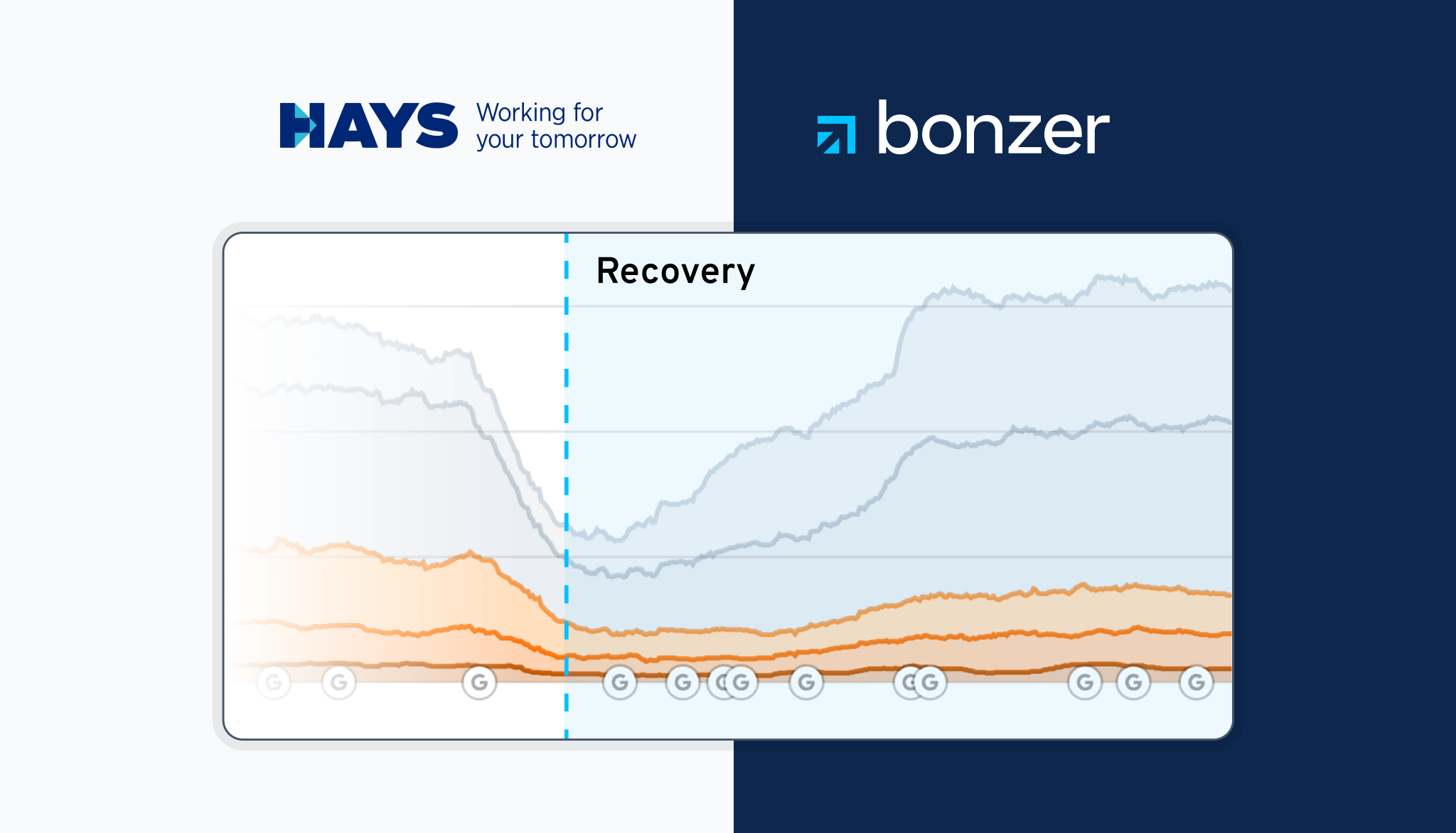
We were facing a concrete challenge with our website, and Bonzer was brought in as a sparring partner on the project, which we certainly haven't regretted. From the very start we've had a genuinely good dialogue, with clear agreements, goals and ongoing follow-up, which has made us feel we were in very capable hands. We've achieved exactly the results we were hoping for.
The partnership with Hays began on 1 June 2022, about a month after Hays had carried out a site migration that, at the time, left their traffic in free fall and down by more than half. The immediate task was clear: provide emergency first aid to the site, stop the free fall in traffic as quickly as possible, and then rebuild what had been lost.
Unfortunately, botched site migrations that cause a website to lose the majority of its organic traffic are not a rare sight.
Once the damage is done and rankings have dropped far enough out of Google's index, there's a significant amount of work ahead, and in cases where action is taken too late, it isn't always possible to recover what was lost. From there, you have to start over and rebuild the lost performance from scratch.
One way to guard against this scenario is to involve an SEO specialist in the migration itself, to make sure all existing value carries over.
Missing out on organic traffic and conversions? Get a free, tailored SEO analysis here
In this case you can read how Hays managed to fix a failed site migration, stop the free fall in organic traffic, and even reach a higher level of organic traffic than before the migration.
Who is Hays?
Hays Denmark is a recruitment agency and part of the global organization Hays plc. Hays' expertise spans several areas, including IT, finance, and sales & marketing. Over the past year, Hays experienced a strong candidate-driven market, a result of the economy and the large number of open job postings. During that period, Hays put extra focus on helping employers find the right talent.
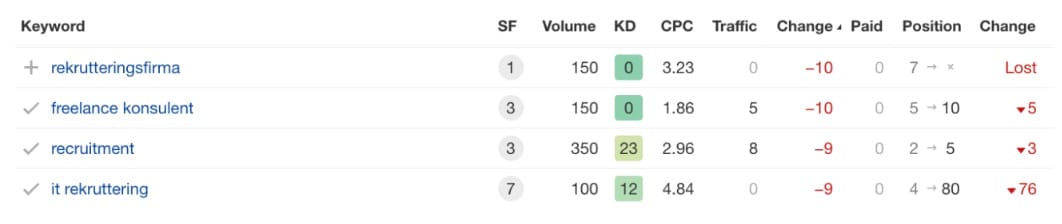
2022 was also the year Hays carried out a site migration, which subsequently caused their most business-critical keywords to lose countless rankings and organic traffic to drop sharply.
Site migrations: why and how they can wreck organic traffic
Let's first clarify what a site migration actually is. It can come in several forms:
- Changing domain name
- Switching to a new CMS
As mentioned, we often see site migrations end in a sharp drop in organic traffic. There are many reasons for this, and the ones we see most often are:
- Errors in redirects
- Content that previously ranked gets deleted or changed significantly
- SEO parameters aren't carried over, leading to worse SEO performance after the migration
In Hays' case, the job was to diagnose what had gone wrong, where, and what needed fixing first.
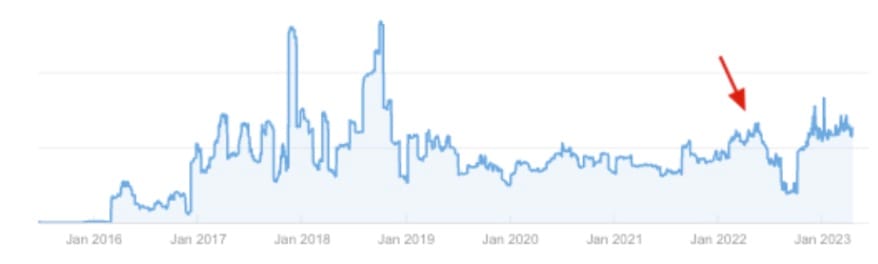
Here you can see exactly when the migration happened, and how organic traffic immediately took a sharp dip.
Proper first aid for the site after a failed migration
The issues we diagnosed were:
- Errors in redirects: When carrying out a site migration, one of the most important tasks is making sure organic traffic isn't lost along the way. You do this by setting up redirects from the old URLs to the new ones. That tells Google it's the 'same' page on a new URL, so the new URL doesn't have to start from scratch in terms of rankings, and anyone visiting the old URL gets redirected to the new one, preserving the traffic.
- 404 pages: Following on from the above, 404 pages are worth mentioning. During a site migration, it's common to see a spike in 404 pages (pages that no longer exist). This happens when old URLs are taken down without being redirected to a new URL.
The main technical challenge was the large number of 404 pages after the migration. This also meant that the redirects set up from the old URLs to the new ones were pointing to 404 pages, so the organic traffic was lost anyway, since the redirects weren't leading to an actual page.
We also made sure their paginated pages were correctly canonicalized, since the parameters previously included in the canonical tag weren't accurate.
Pagination also lacked the HTML markup search engines rely on to follow the link to the next page in the sequence, which meant paginated pages were interpreted as dead ends.
Another significant issue was leftover remnants from old designs scattered throughout the code, such as links to search pages or pop-up modals that no longer worked or pointed to retired pages. The buttons had been made invisible so users wouldn't end up on them, but that didn't stop search engines or crawlers from following them anyway.
Once we'd found all the issues with broken redirects, missing redirects, invisible 404 links, and pagination that worked fine for users but not for SEO, we started building on their existing site structure so the purpose of each page was easier to understand.
Recovering the lost ground, and performing better than before the migration
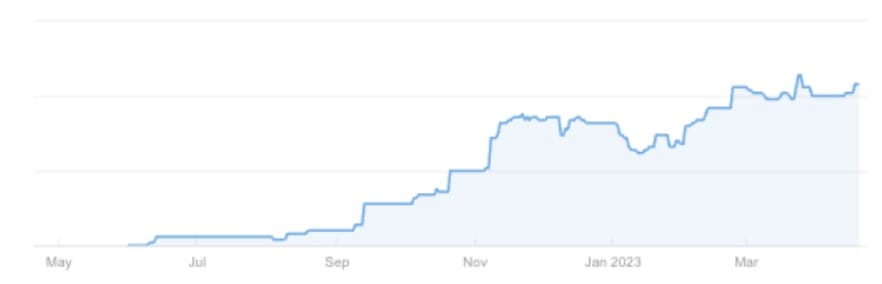
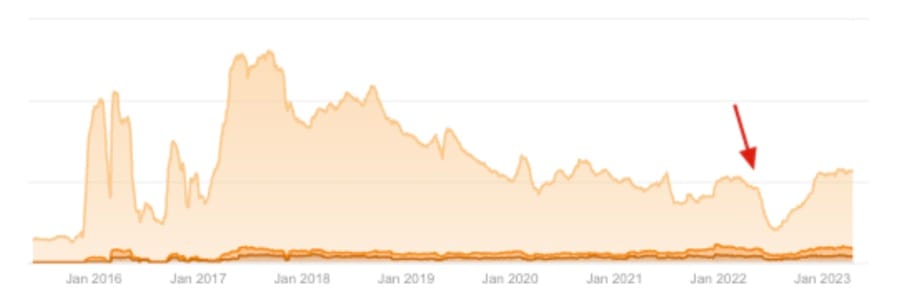
As soon as the fixes above were implemented, we saw the curve start to turn. The sharp decline in metrics slowed, then gradually climbed back up and recovered what had been lost. Within two months in total, Hays was in a better position than before the migration, measured on organic traffic and indexed keywords.
Today, the site has more keywords indexed than before the failed migration:
Need a clearer view of your SEO situation and potential? Get a free, tailored SEO analysis here
This is because, beyond fixing the migration itself, we optimized the site holistically, especially its existing content. The first issue was that there were English articles on the Danish site. A mix of Danish and English confuses both users and search engines. So we had the English articles translated and did a broader cleanup of the site.
From there, we went in and optimized existing content where keyword rankings and organic traffic were declining, aligning each page with a clear search intent and a target keyword.
Last but not least, we developed new content for the site. We based this on Hays' goal of targeting companies that are looking to recruit, by expanding their specialist areas with more in-depth content in line with Google's "helpful content" update.