Nov 24, 2026Research8 min read
AI Has Decreased Competition in Search – Here’s Why

Many marketing leaders believe AI made search competition ten times harder.
The logic seems obvious: when anyone can spin up dozens of articles in minutes, the web gets flooded with content.
In my opinion, the reality is the exact opposite. While the volume of published pages has exploded, the actual competition for top rankings and LLM citations has gone the other way.
AI has set the direction for how countless industries evolve – and how we work as professionals. The tools have brought more opportunities than ever before, and just a few years into this new era, it is hard to imagine a workday without them.
We use AI - like Claude and ChatGPT - for research, ideation, structuring, and data processing. LLMs have become our regular sparring partners and agents.
But what happens to company output when AI shifts from being an assistant to taking the steering wheel? What happens to the quality of our content – and to our own ability to think critically and originally?
A recent study from MIT Media Lab examined brain activity (via EEG) in people writing essays using ChatGPT vs. people writing entirely on their own. The result was striking: a 32% reduction in active mental effort and a measurable decline in brain network connectivity for those who relied on AI.
Is that inherently bad? Not if the goal is to free up cognitive resources for deeper strategic considerations. But if this evolution means our professional muscles atrophy, our ability to deliver genuine substance declines. We end up like a swarm of fruit flies buzzing around the same synthetic average content.
Where marketing stands right now: Pros vs. cons
Today, it is estimated that over 80–85% of modern marketing teams use generative AI in their content workflows. But while speed is skyrocketing, a polarization is taking place:
- The advantages of AI: Scaling research and briefs, eliminating "blank page syndrome", lightning-fast data structuring, and removing trivial manual tasks.
- The disadvantages (if you let go of the wheel): Massive amounts of "content slop", generic phrasing without an edge, hallucinations, uniform pacing, and zero differentiation. When everyone prompts the same models on the same sources, everyone essentially produces the same answer.
Google and other tech giants draw a red line
This is not just a philosophical debate – it has direct consequences for your business and organic visibility:
1) Google just updated its guidelines for gen-AI and Helpful Content
Google clarifies that language models do not retrieve verified facts, but calculate word probabilities based on training data. Therefore, Google now explicitly recommends manual, human fact-checking and review prior to publishing to counter hallucinations and inaccuracies.
2) Quality assessment
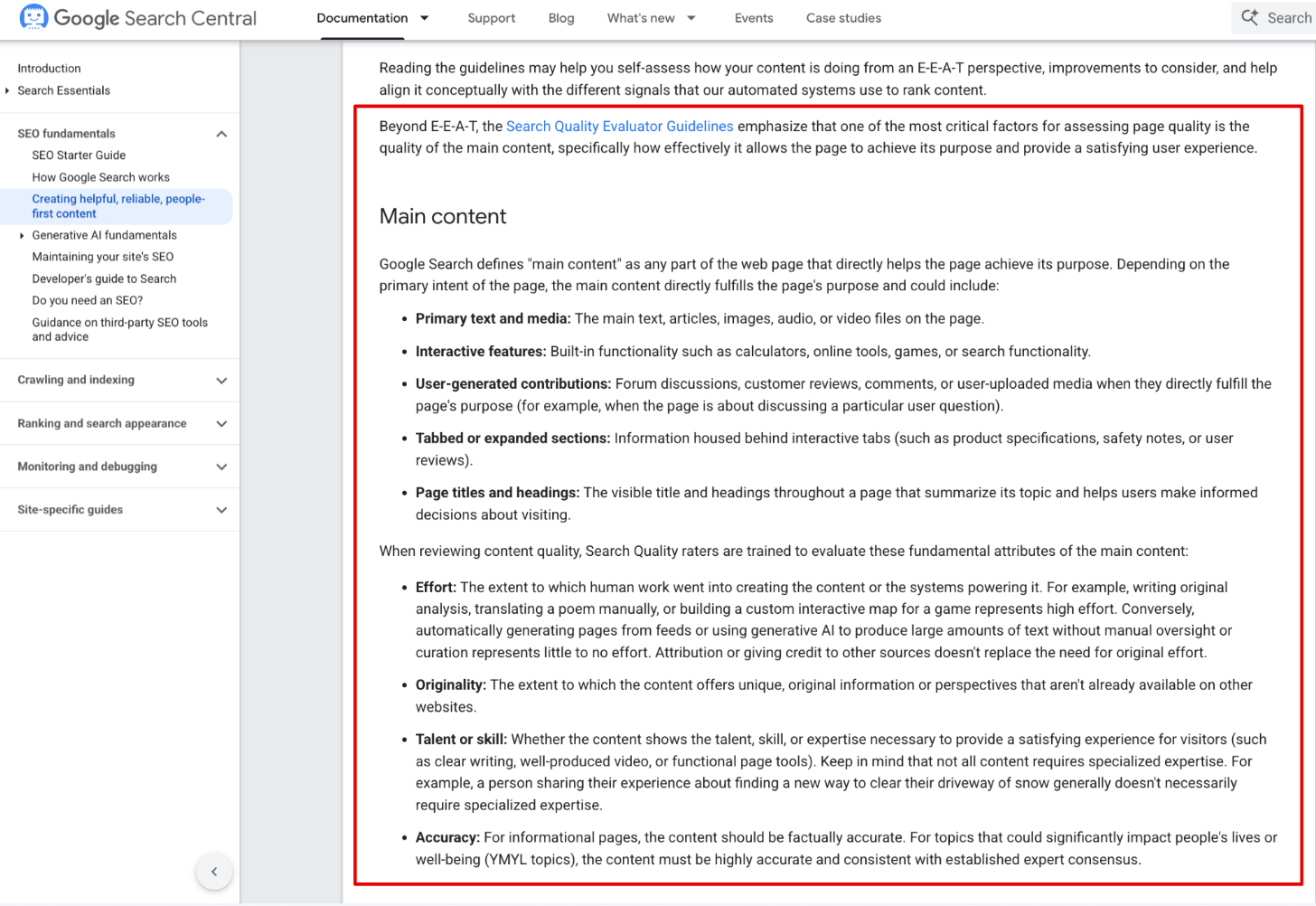
In its Search Quality Rater Guidelines, Google instructs raters to assess the human effort and originality behind a page's main content, assigning the Lowest rating to scaled content that adds no genuine value. Simultaneously, Google's Search Spam Policies explicitly classify scaled content abuse - generating unoriginal pages in bulk to manipulate rankings without editorial oversight - as spam.
3) Traceability and watermarks
Both tech giants and model providers such as Anthropic and OpenAI have implemented watermarking and metadata (such as IPTC TrainedAlgorithmicMedia and C2PA). Search engines and LLM citation systems are becoming exponentially better at identifying synthetic mass production. Not because mass production is an isolated issue, but because it typically leads to generic content.
From theory to penalty: How Google’s spam updates are purging AI slop
This shift is not theoretical future-proofing. It is already actively wiping domains off the SERP.
Back in early 2023, when ChatGPT had just launched, we predicted on the Bonzer blog that uncritically outsourcing content departments to pure AI prompts was a "starstruck move." We cautioned that relying solely on AI outputs without proprietary experience would drown brands in generic duplication - and that Google would inevitably step in to separate real human insight from recycled text.
Three years later, that prediction has played out across every major search update.
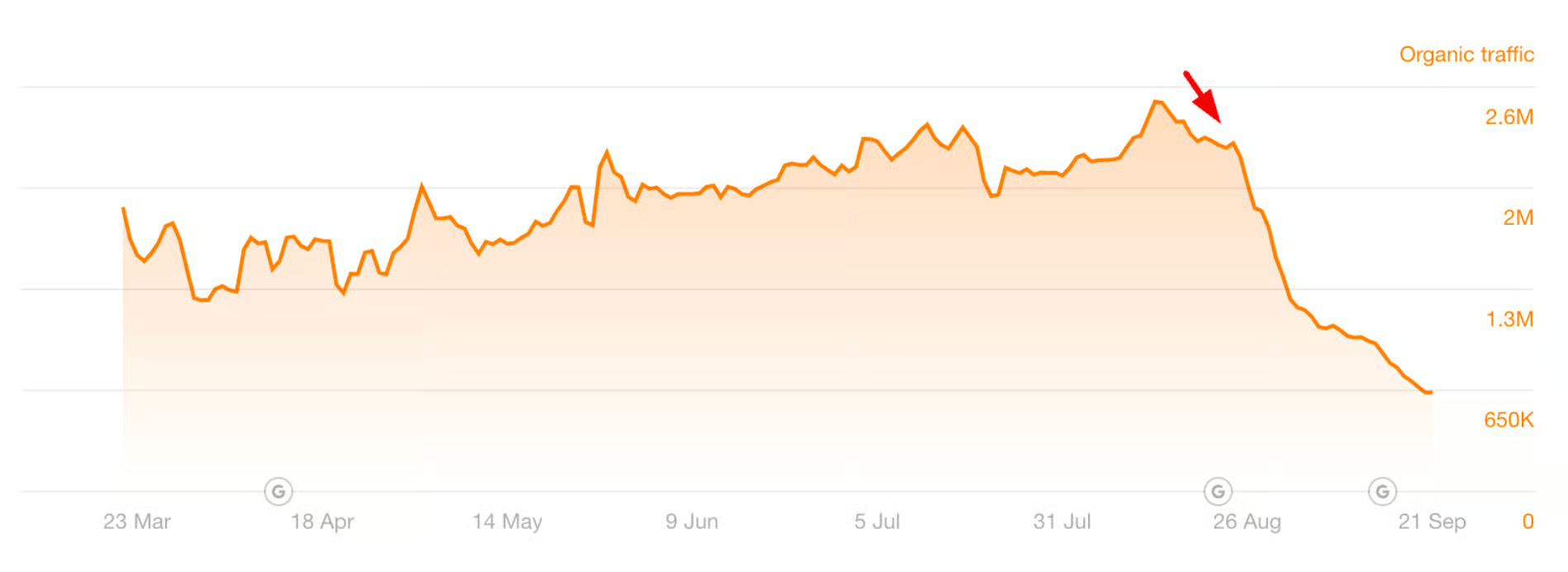
Recent analysis reported by Search Engine Journal shows that Google’s recent spam sweeps have zeroed in directly on programmatic, template-driven AI content engineered purely to capture search rankings.
Google even published research on a framework known as S-CTS (Scalable Cluster Termination System), engineered specifically to identify and terminate entire networks of mass-generated synthetic content.
The pattern of who wins and who loses in these updates is telling:
1. The Losers: Domains that jumped straight into full-scale automation without any unique data or perspectives - spinning up generic content with identical subheading patterns, expanded bullet-point filler, and no established user engagement. Sites with zero historical domain trust or proof of human involvement saw rankings collapse across the board.
2. The Buffer Effect: Brands that previously built authority through manual, high-quality work were initially insulated by existing domain trust. But even for them, relying on automated posting without manual review began eroding visibility as search engines tuned their detection.
3. The Survivors: The publishers that weathered the updates were not anti-AI - they were anti-slop. As post-update industry reports confirmed, organizations that safely scale AI keep mandatory, manual human fact-checking and editorial reviews before hitting publish. They add original perspectives, unique testing data, and proprietary angles that cannot be reverse-engineered from a prompt.
It reinforces the core principle: Google does not penalize you because you used AI. Google penalizes you because the content manipulated the index without adding any unique, human-verified value.
When search engines actively purge low-effort, mass-produced text, the competitors flooding Google with uncurated AI drafts are not threatening your positions. They are eliminating themselves from the race.
The perfect mix: Humans in the driver's seat, AI as an accelerator
It is an illusion to think we will go back to a world without AI in content creation. AI is here to stay, and we must utilize it to optimize our processes.
Winning is all about striking the right mix.
Many still believe SEO is about looking at what competitors are doing and then doing it 10% better or 10 times faster. That no longer works.
In a world flooded with AI text, you win by bringing your own unique experiences, proprietary data, product insights, and professional viewpoints into play. That is the core of E-E-A-T (Experience, Expertise, Authoritativeness, Trustworthiness).
This realization is why we built Morrison at Bonzer.
We believe the best use of AI is not prompting a blank LLM to generate generic text from scratch. The true power of AI is deploying an intelligence layer that actually understands your brand, your product, and your site context down to the smallest detail - and gives you original ideas and strategic workflows from that foundation.
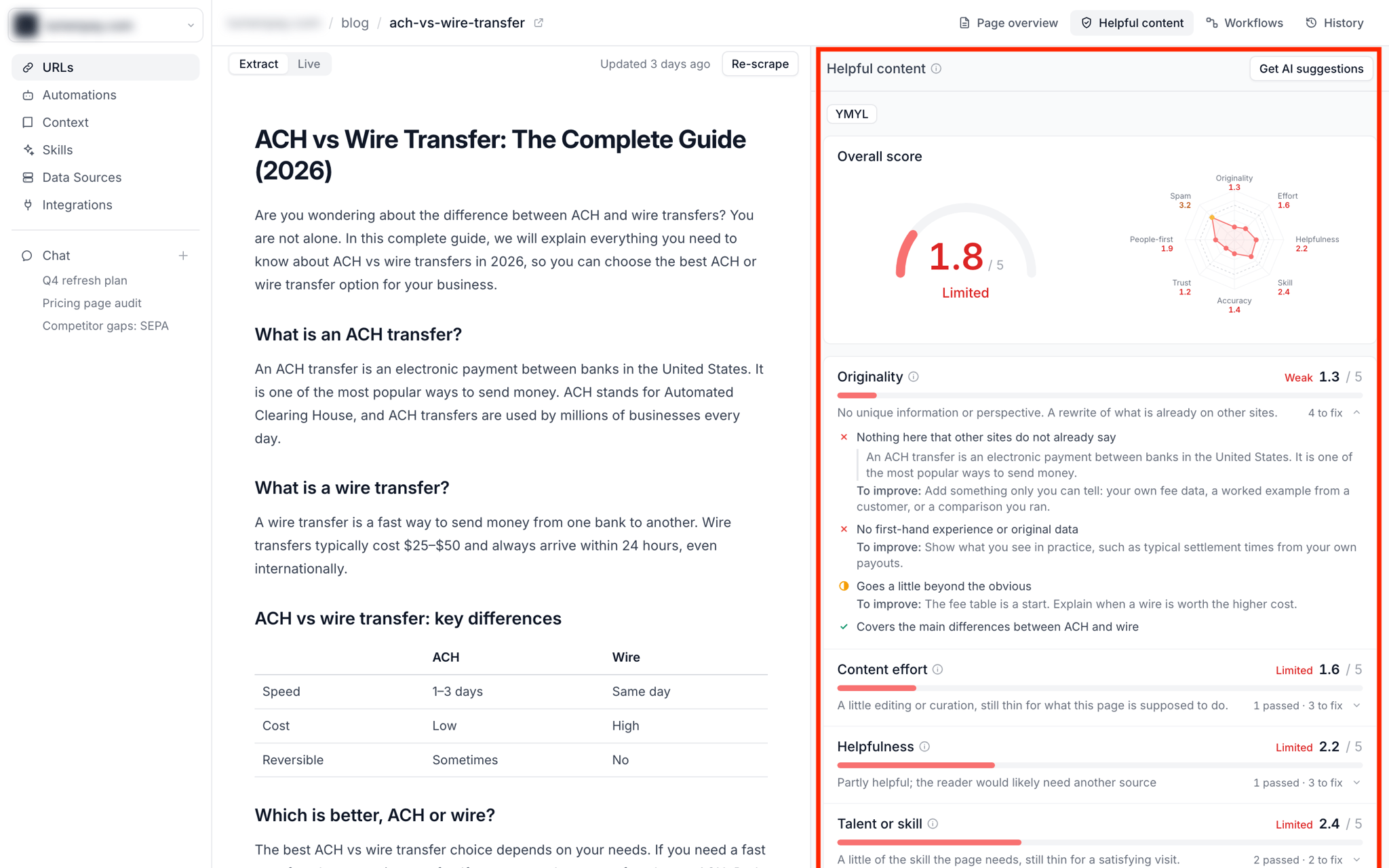
That is also why we recently launched Morrison’s Content Analyzer: After every crawl, it automatically evaluates every single page against Google’s helpful content and spam guidelines across eight core dimensions - including Originality, Effort, Accuracy, and Trust. It flags unhelpful, synthetic AI-content immediately, points out exactly what is missing, and shows how to inject real human effort and unique substance before Google or users penalize it.
That this context-first approach works was proven in our collaboration with Pleo, which earned us a nomination at the Global Search Awards for best B2B case.
Through a focused, E-E-A-T-driven content strategy with deep human expertise and sharp technical execution, we achieved a +2,670% increase in B2B referral traffic from AI search engines and LLMs (ChatGPT, Perplexity, Claude, etc.) in a single year.
Why? Because LLMs prefer to cite sources that own original knowledge rather than those merely recirculating consensus.
Your takeaway as a marketing leader
AI has decreased competition in Search – at least content competition. Does that mean overall competition in Search is low? Definitely not.
There are still plenty of ranking factors companies need to master to gain visibility. But scaling generic AI content with zero uniqueness won't make an industry harder to compete in - it actually creates more room for you to stand out with real human experience. Here are a few key takeaways to keep in mind:
Use AI to accelerate processes – never to outsource your critical thinking. Let AI handle drafts, research, and data organization, but keep the core idea, angle, conclusion, and fact-checking with subject-matter experts.
Audit your pages for real "Effort" and Helpfulness. Test your content against Google’s criteria. If a page offers zero new data, zero unique perspective, and zero proof of human effort, it will not survive future search updates.
Get your "evidence house" in order. Back your claims with credible sources, authors with real expertise, and concrete numbers.
Stop copying your competitors. Deliver what your target audience is genuinely looking for, articulated in your own tone of voice and backed by your own firsthand experience. It's your unique product and knowledge that will bring home the gold in the end.
When everyone else is making themselves dumber and more uniform by uncritically hitting "Publish" on AI text, original, human-crafted quality suddenly becomes your greatest competitive advantage.
AI shouldn't be replacing your content creation - it should support it.