Sep 25, 20266 min read
Search Engine Recap - August (2026)

Here's your monthly overview of the biggest news from the search engines, so you can keep your SEO strategy ahead of the competition. Welcome to our recap of August 2026.
Welcome to a new monthly recap, where we go through several major updates from Google, Anthropic and OpenAI. We look at a new spam update, changes to Site Reputation Abuse enforcement in the EU, new AI reports in Search Console, and interesting developments in personalization and AI advertising. Here's your overview.
Google rolls out the August 2026 Spam Update to sharpen enforcement
On August 18, Google launched its August 2026 Spam Update, which finished rolling out globally across all languages after two days and 16 hours. The update aims to improve Google's automated detection systems, including SpamBrain, so they can identify and act on policy violations more effectively.
The update does not introduce new policies, but it has led to markedly stricter enforcement of the existing rules, causing significant volatility in search results. As much as 16.7% of monitored URLs in the top 10 dropped out of the top 100 entirely, an 82% increase in severe ranking drops compared to the previous month.
For our readers, this means you should review your Search Console data from August 21 onward to spot any sudden traffic drops. Go through your content against Google's spam policies, with particular focus on low-quality AI-scaled content, doorway pages and manipulative link profiles, and avoid making hasty changes before your baseline traffic has stabilized.
Google splits Site Reputation Abuse enforcement for users inside and outside the EU
On August 28, 2026, Google updated its Site Reputation Abuse policy by removing manual ranking penalties for searches performed within the European Economic Area (EEA). The change follows regulatory discussions with the European Commission in light of the EU's Digital Markets Act (DMA).
Website owners will still receive global manual action warnings in Search Console, but the penalty will now only devalue content for users outside the EEA. For European search results, Google will instead strip domain authority from the affected section and evaluate the content strictly on its own isolated quality.
We recommend running a thorough audit of any third-party, sponsored or white-label content sections on your domains. Identifying potential Site Reputation Abuse risks is critical to staying compliant with the global guidelines and protecting your overall visibility.
Google Search Console rolls out AI reports and opt-out globally
Google has now completed the global rollout of its new generative AI performance reports in Search Console. With this update, site owners can track impressions from AI Overviews, AI Mode and Discover AI directly in the familiar analytics tool.
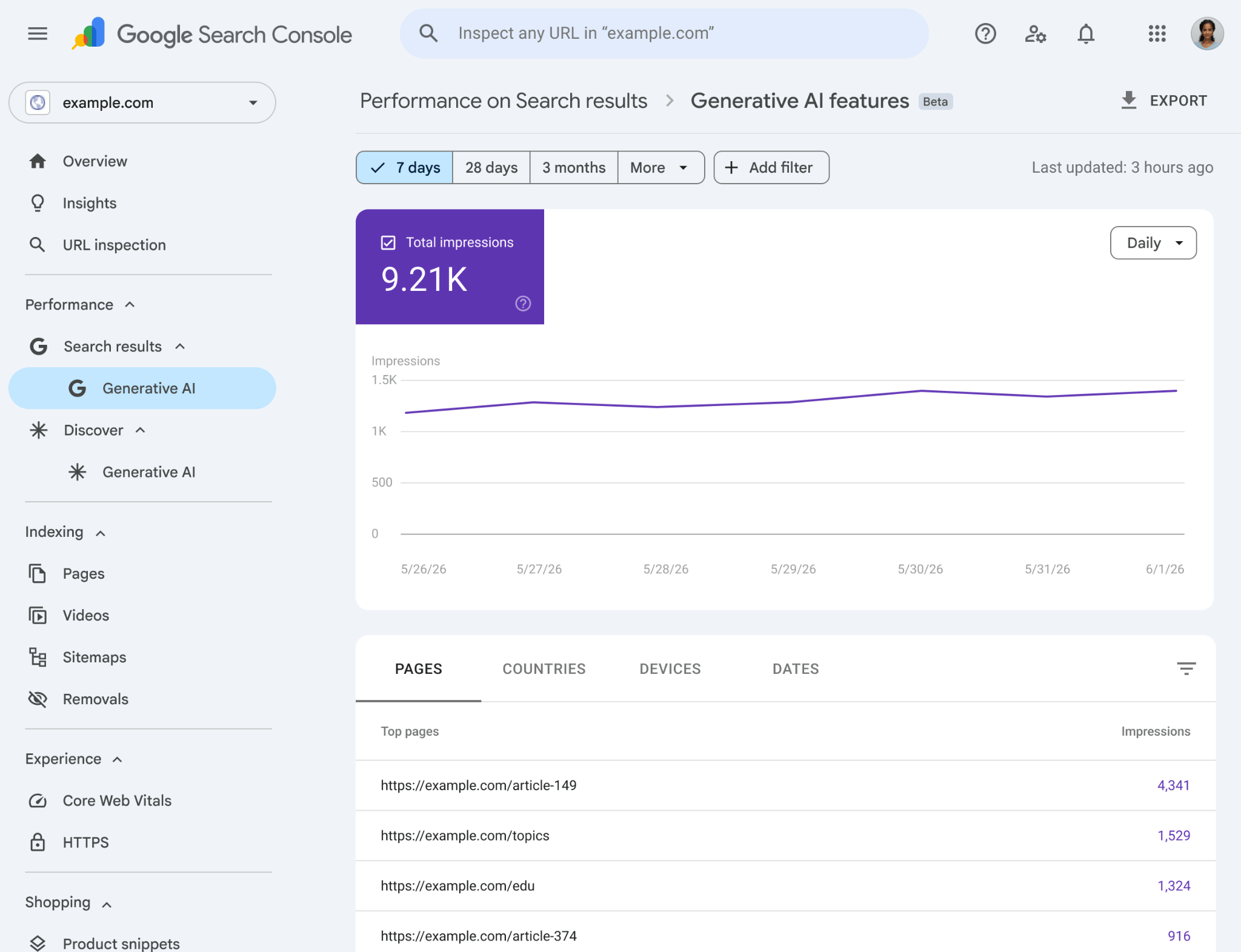
The update also introduces a new property-level setting that lets you opt out of appearing in these AI features. Worth noting: the new reports currently track impression counts only and do not yet provide click data for AI-generated results.
Go through your Search Console data across your domains to establish a baseline for your generative AI impressions. Use the data to identify your most cited AI pages, find relevant keywords to optimize for, and verify your settings carefully before testing the opt-out options.
Google expands personalization with "Preferred Sources" and Discover prompts
Google has launched a new, embeddable "Preferred Sources" button that publishers can place directly on their websites. When a user clicks the button, the site is added to the user's explicit Google preferences, and they are immediately returned to the page, boosting the site's visibility in Top Stories, AI Overviews and AI Mode.
The update also introduces new natural language controls in Discover via the three-dot menu. This lets users enter specific preferences (such as "eco-friendly kitchen renovation") to dynamically tailor and save their personal feed settings in real time.
We recommend auditing your most visited blog pages and integrating the new Preferred Sources button using the code from Google's Search Central documentation. By encouraging your most loyal visitors to mark your brand as a preferred source, you can secure a significantly higher share of impressions in Google's personalized results.
Anthropic shares details on Claude's new AI text watermarking system
Anthropic has announced it will implement an invisible AI text watermarking system in future Claude models to comply with the EU AI Act. The system works by embedding a hidden statistical pattern in the text, adjusting the underlying mathematical probability of the word choices the model makes.
This watermark can later be identified with a dedicated detector key that recognizes the specific word pattern. The signal weakens significantly or disappears entirely in very short passages, in highly factual content, or if the text is later rewritten and rephrased to a meaningful degree.
You should review your processes for AI-assisted content production to ensure that text generated by Claude goes through a thorough rewrite. Rephrase at the sentence level and build unique structures, rather than making light edits, so the underlying word-choice patterns are fully erased before publishing.
OpenAI expands ChatGPT Ads to 31 European countries
OpenAI has rolled out ChatGPT Ads to 31 European markets for users on the Free and Go plans, also giving broader access to its self-serve Ads Manager. The ad business has reached a global annual revenue run rate of 1 billion dollars in just 200 days and now introduces conversion bidding, custom audiences and pixel tracking.
This expansion opens up entirely new advertising opportunities in the AI-driven search landscape. It also creates an even stronger synergy between paid and organic visibility, as presence in AI search becomes critical for reaching users in the early and mid stages of the buying journey.
For our readers, this means you should consider testing OpenAI's Ads Manager in your European campaigns. Implement the OpenAI Pixel for conversion tracking, build targeted conversational strategies for mid-funnel buyers, and keep strengthening your organic AI search visibility, since there is a direct correlation between the two disciplines.
Takeaways and recommendations
August once again showed that the search landscape is changing at unprecedented speed, with Google, Anthropic and OpenAI all setting new standards for the future of search.
We see a clear trend toward deeper and more nuanced AI integration, from the new AI reports in Search Console to the rollout of ChatGPT ads in Europe and tighter transparency requirements through AI watermarking.
At the same time, Google's latest spam update and the geographic differences in Site Reputation Abuse enforcement are a reminder that quality, technical compliance and unique content remain the most important factors for staying visible in search.
If you manage to adapt your SEO and content strategy to these new personalization options, AI reports and quality requirements, you will be in a strong position going into autumn.
Want help with any of the above? Get in touch with Bonzer. As a specialized SEO agency, we help ambitious companies achieve maximum visibility in the search engines every day.