How Gemini and AI Mode Work
Gemini is Google's AI model, and AI Mode is the search experience it powers. Understand how both work, and how you optimize your visibility in them.
For twenty years, searching meant typing keywords and getting the same list of results as everyone else. That is now changing, and not only because of AI Overviews. Google has been rolling out AI Mode across the world, and it works on a different principle from the ten blue links.
What AI Mode is
AI Mode is Google's most capable search experience. Where AI Overviews give a short answer above the classic results, AI Mode goes considerably deeper and behaves like a conversation with memory.
The difference is in what it is designed for: complex queries, multimodal input across text, images and voice, and answers assembled from many sources at once. Instead of one quick response, the user gets a composed answer with explanations, resources and links, plus obvious next questions to ask.
Request a free SEO analysis
Google's Gemini model powers this, and it enables a mode of work Google calls Deep Search: a query is broken into sub-questions, each researched separately, and the answer comes back as a sourced report that would otherwise have taken a person a dozen manual searches.
AI Mode also adds what Google calls agentic capability. The assistant does not only inform, it can act.
Imagine searching: "Find a restaurant for three people this Friday at 6pm. We want ramen or bibimbap."
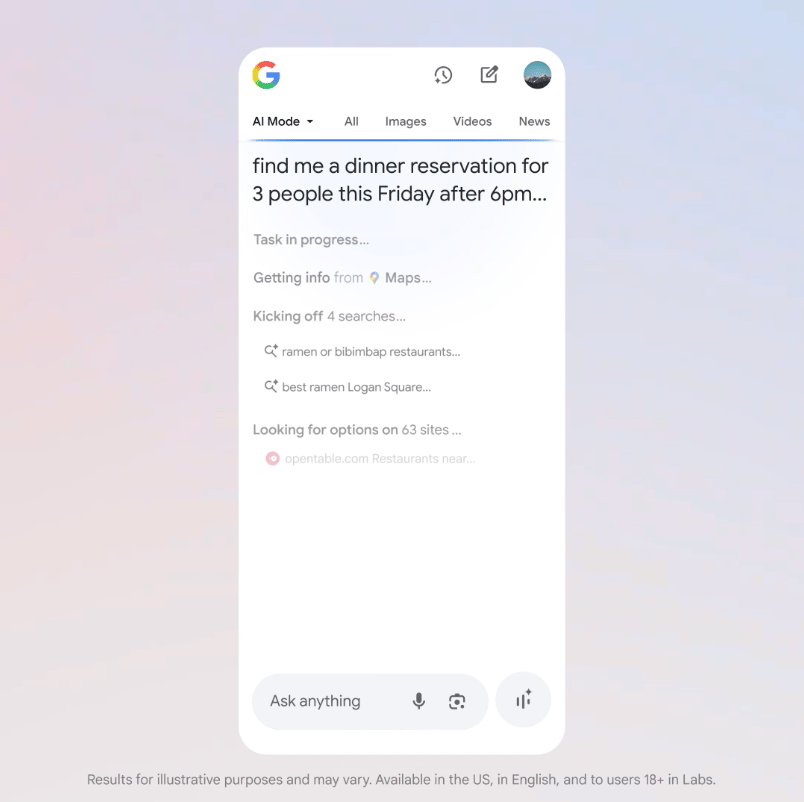
Rather than listing restaurants, AI Mode can check availability through partners, Maps and the Knowledge Graph, and come back with bookable options. That is a different relationship with a search engine. Google stops being a place you look things up and starts being an assistant that does part of the task. It can also carry your earlier queries into new ones, so the answers get more tailored the longer the session runs. The same pattern is spreading across the assistants, which is the subject of agentic search.
AI Mode is dynamic, and it shows more links
Results in AI Mode vary far more than classic results do. Research from SE Ranking found that repeating the same query in AI Mode produced only around 9% overlap in the sources cited between runs.
Two things follow from that. The obvious one is opportunity: a wider, more varied set of sources gets surfaced, which opens the door for players who never cracked the top three in classic results. The less obvious one is that consistency across runs is itself a signal of strength. Being picked repeatedly, when most sources are not, is a real competitive position.
Google has also confirmed it will show more links inside AI Mode, in link carousels on desktop and as smarter inline links in the text. For businesses that means more entry points to earn, with sharper competition for each of them.
Where it is available
Google has made AI Mode available in more than 180 countries, so a very large share of users can already test it in their own searches. The rollout has moved more slowly across the EU, where Google has waited for the regulatory picture to settle before switching features on.
If your market is one of the ones still waiting, that is a head start rather than a delay. The optimization work is the same work either way, and doing it now means being ready on day one instead of catching up afterwards.
How to optimize for AI Mode
AI Mode changes the user experience, and it raises the bar on SEO and content at the same time. The work that pays off:
- Build authority and E-E-A-T deliberately. Make sure your content signals experience, expertise, authority and trust. Google is selecting sources it can stand behind, and that selection gets stricter the more the answer is synthesized rather than linked.
- Write comprehensively, not narrowly. AI Mode draws on content that answers a topic fully. Think in topic clusters, and cover a subject from several angles. Our own work runs on pillar-cluster structures for exactly this reason: they earn visibility in classic results and in AI interfaces from the same investment.
- Produce more than text. The more formats you publish in, the more ways an AI interface has to use your material. Text, images, video and audio all count, which is the subject of visual and multimodal content, and the extra formats lift conversion rate as well.
- Diversify where you are visible. Because results vary so much between sessions, breadth pays. Your own site matters, and so does being present in the sources Google trusts, which is where digital PR does the heavy lifting.
- Structure content so it can be extracted. Clear headings, lists, structured data and clean metadata make it far easier for a model to pull the right passage and attribute it to you.
- Write for clickability. Expect your links to appear in carousels and inline formats. Titles, descriptions and individual sections should make sense as stand-alone snippets, because that is how they will be shown.
- Bring local SEO in. AI Mode leans on Maps and local signals. If you serve a geographic market, your Google Business Profile and the rest of your local SEO matter more here, not less.
- Keep content fresh. Content that is updated and accurate gets crawled more often and performs better than content that was correct two years ago. Freshness is one of the cheapest advantages available, and almost nobody works it systematically.
The shift underneath all of this is that ranking first stops being the whole objective. The objective is being present, and being quotable, across a wider and more variable set of answers, with the person on the other side of the query in mind rather than the algorithm.
If you want to know how your domain performs in AI answers today, that is what our free SEO analysis is built to show, and AI search optimization is where the findings turn into work.