CRO in Content
Conversion rate optimization turns SEO traffic into customers. Get the mechanics behind search intent, value propositions, CTAs and pages that sell.
Plenty of visitors, very few buyers. It is one of the most common patterns we see on sites with healthy SEO, and it is the point where conversion rate optimization stops being a nice-to-have.
Your conversion rate is the share of visits that end in a sale, a lead or whatever else counts as a result for you. It is one of the few numbers where a small improvement changes the economics of every other channel you run, because it raises the value of traffic you have already paid to earn.
What conversion rate optimization is
Conversion rate optimization (CRO) is the work of raising that share through analysis and testing rather than through more traffic. You map how people actually move through the site, find where they hesitate or leave, change something specific, and measure whether the change held. If the lift is real, it stays and you look for the next one.
Because most of the work is about removing friction and making the next step obvious, CRO overlaps heavily with UX. The difference is the target: UX aims at a better experience, CRO aims at a higher conversion rate. They usually pull in the same direction.
The commercial argument is straightforward. Revenue goes up without more visitors, the increase carries no extra media cost, and the higher return gives you room to invest in getting more traffic in the first place.
What counts as a good conversion rate
Industry benchmarks usually land between 2% and 5%, so roughly two to five out of every hundred visitors do the thing you wanted. That average is a weak reference point on its own, because the number moves with channel, device and where the visitor sits in the buying process.
Not every page has, or should have, the same rate. Someone on a product or category page is far warmer than someone who clicked into an informational guide or your team page. A guide that converts poorly on sales but brings in the traffic that later converts elsewhere is doing its job.
So set the goal per page type rather than per site. A page with one clear purpose and a realistic target beats a site-wide number nobody can act on.
How conversion rate and SEO feed each other
CRO is often treated as a separate discipline from SEO, and the two influence each other more than that suggests.
Organic traffic arrives from every stage of the buying process at once. Some visitors are ready to buy. Others are still working out whether they have a problem worth solving. That mix is a consequence of how you targeted your keywords, and some keywords carry far more commercial intent than others.
Working on both at the same time compounds. Better conversion means new traffic is worth more, which justifies investing in more traffic, which arrives on pages that now convert better. Conversions also tend to come with the behavior search engines read as a good result: people go deeper into the site, spend longer, and return to the results page less often.
The moment the decision gets made
Google's own term for the research phase before a purchase is the Zero Moment of Truth, and it maps almost directly onto what happens in a search engine.
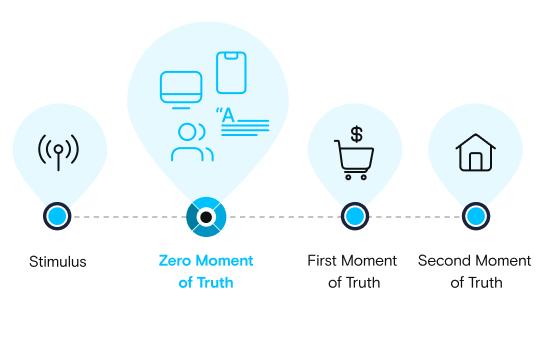
Something triggers a need, and the first thing we do is look for information: things that make us better informed, that compare options, and that guide us toward a choice. The companies that are visible in that phase, that contribute the most useful information, and that deliver a product matching the need are the ones that end up with the conversion.
Searches in that phase divide into four classic intents, and each needs a different page:
- Navigational. Someone looking for a specific site or page.
- Informational. Someone looking for information about a topic.
- Commercial investigation. Someone comparing options for a product or service.
- Transactional. Someone ready to buy a product or from a brand.
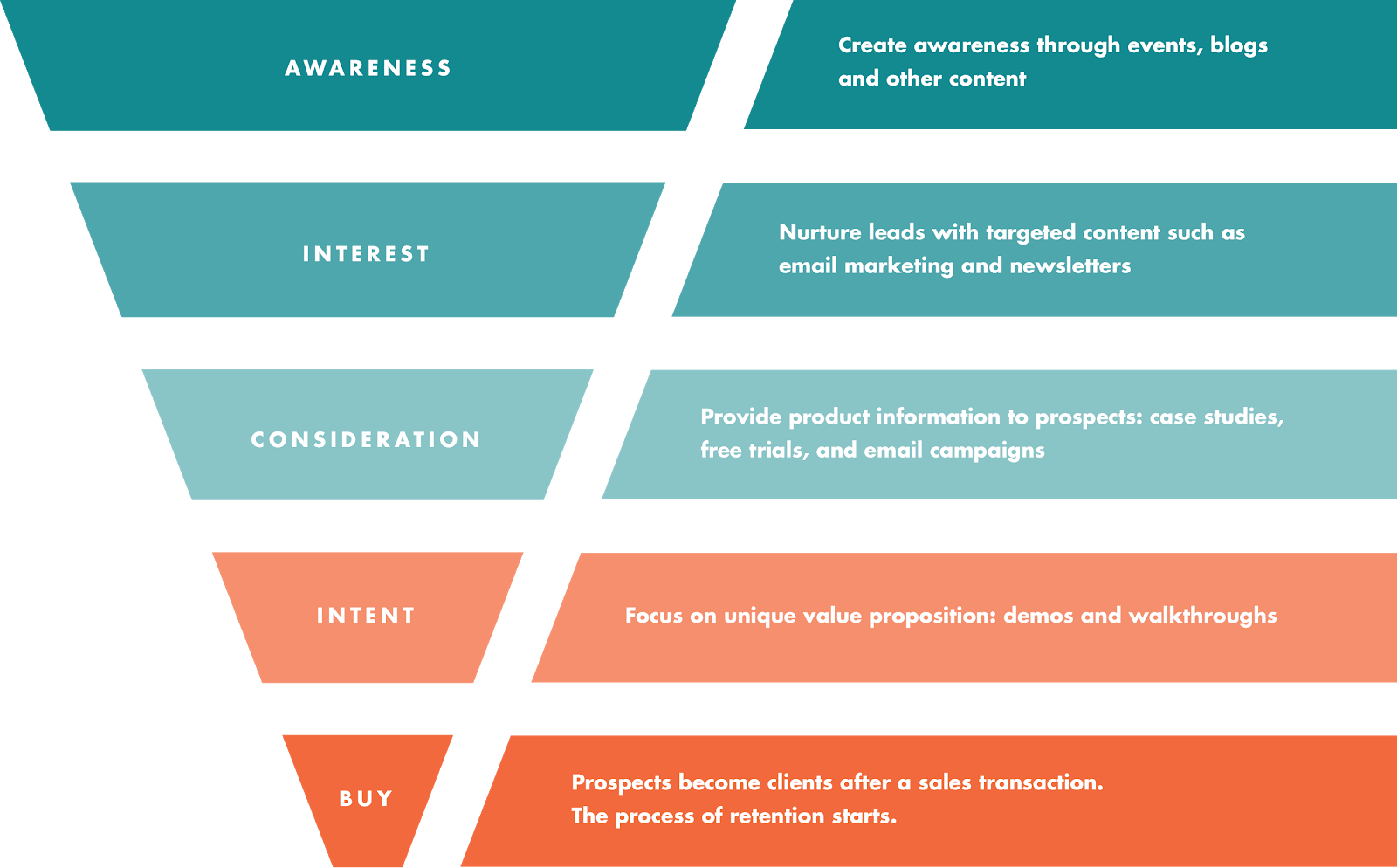
The funnel is the same idea drawn as a shape: awareness at the top, purchase at the bottom, and channels crossing each other on the way down. It is a simplification, and real journeys loop and double back, but it is a useful one for deciding what a given page is supposed to do. We go deeper into the models and their limits in our post on the marketing funnel.
Three levers that move the number
Make the payoff explicit. A value proposition states what the visitor gets, not what you sell. Most of us are not motivated by the product itself, we have a problem the product solves: nobody buys a drill, they buy a hole. Reassurance belongs in the same category. Free returns and a visible refund policy on a shop's front page mean the buyer no longer needs to be certain, only curious, because the risk of being wrong has been removed.
Use video where the product is hard to imagine. Short clips make a page feel alive and answer questions text cannot: how a garment moves, how a tool is held, how a piece of software actually behaves. Fashion and jewellery brands lean on it heavily for exactly that reason. Production value matters less than accuracy, and a plain phone recording works as long as it matches how the brand looks elsewhere.
Give the page one job. A call to action should ask for something with commercial value: request a quote, get in touch, add to cart. Work with one, at most two, so the visitor is never choosing between competing invitations. This matters most when you sell services rather than physical products, because the CTA has to make an abstract offer concrete.
Where the work actually happens
Two things decide whether the levers land. The first is that your commercially important pages are built for it: pages tailored to one search intent, with a headline, structure and CTA that follow from it. That is the subject of our guide to landing pages that convert.
The second is choosing the right keywords in the first place. CPC data from Google Ads is a useful proxy here, since the price advertisers are willing to pay signals commercial intent, which is why we use traffic value rather than raw volume when we prioritize. That decision belongs in the keyword research, not in a later optimization round.
CRO does not finish. It runs as a rhythm: look at the numbers, pick a change, ship it, measure, repeat. If you want that rhythm running on your commercial pages, conversion rate optimization is a focused sprint on top of a baseline. And if you want to know which pages are closest to a win right now, our free SEO analysis will tell you where the traffic is landing without converting.