SEO Strategy
An SEO strategy is the bridge between where you are and where the business is going. Get the frame: the three pillars, competitor analysis, time horizon and AI search.
An SEO strategy is the bridge between where your site is now and where the business needs to be in a year. Everything else, the keyword list, the technical backlog, the content calendar, is downstream of that decision.
Settling on one is hard because too many options are defensible, and almost any of them produces some improvement. The job is finding the one that matches what your site needs and what the business is trying to achieve, which are not always the same thing.
Request a free SEO analysis
Good SEO takes time, and the data is blunt about it
If you need results in the next few weeks, this is the wrong channel. Search rewards patience in a way that is measurable.
A large study by Ahrefs looked at the age of pages holding top positions:
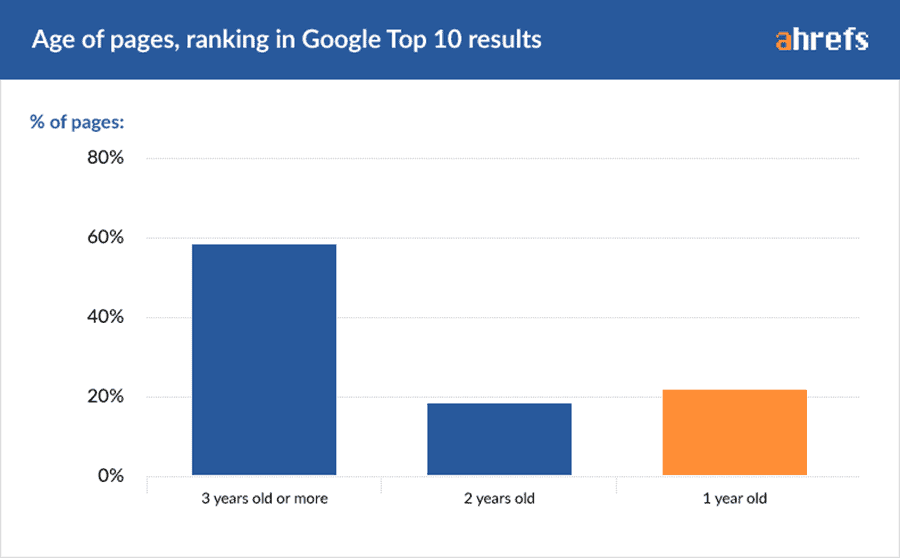
The great majority of pages in the top 10 are at least three years old. Narrow it to first place and the picture gets sharper:
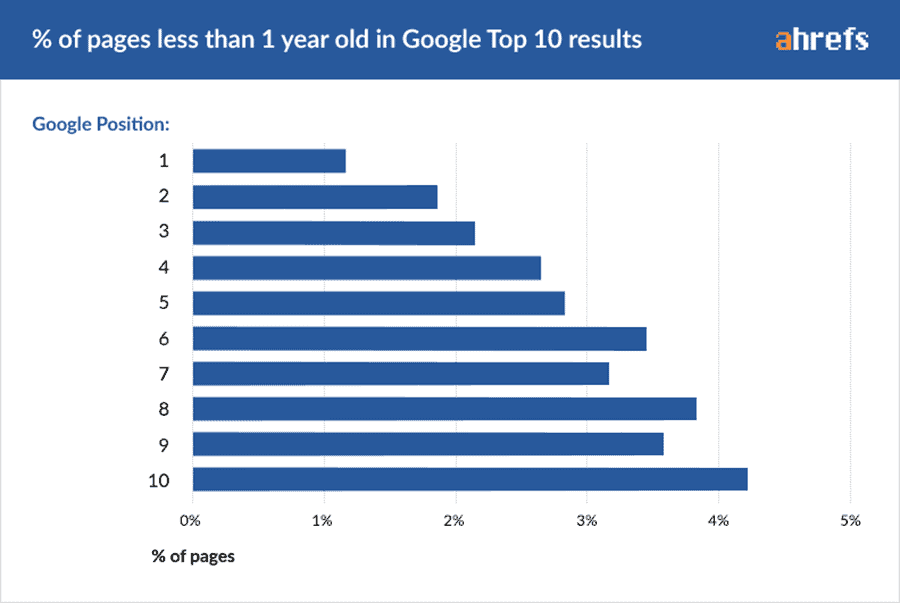
Just over 1% of first-place results are held by a page less than a year old.
Remember what sits in that sample though: every site on the internet, including the large majority doing no SEO at all. Winning with a new domain is far from impossible. It takes a strategy rather than activity.
Aim at 6-12 months. We build strategies on a minimum six-month horizon, because algorithms keep moving and because the compounding effects, authority and topical coverage, need time to show up. The best results tend to arrive near the twelve-month mark.
Get a team around it
Search is multidisciplinary, and knowing which role is missing matters more than knowing which is filled. Five roles carry a real strategy: a strategist who owns the plan, a developer fluent in your stack, a writer who can produce content that ranks and still sounds like a person, a designer for the diagrams and video that AI surfaces pull from, and a link builder who is really a PR specialist. One person often covers several, and the gap you cannot cover is where a hire or an agency becomes the decision.
The three pillars
We plan every strategy against three pillars, and the allocation between them is the strategy.
Content
What relevant content exists today, and how does it perform? A content audit is where the uncomfortable findings live: pages cannibalizing each other, duplicate content, thin pages that dilute the domain, and content that answers a different question from the one the keyword implies.
Questions to answer:
- What is on the site now, and how much of it gets organic traffic?
- Which keywords do you want to own, based on a real keyword analysis?
- Does the existing content match the intent behind those keywords?
- How much needs producing, and how much needs deleting?
That last question is the one most teams skip. On many sites more than half the pages get no organic traffic at all, and consolidating them is faster than writing new ones.
Authority
How many valuable links point at the site, and from where? Authority is still a ranking signal, earned through credible, relevant links rather than bought. Bought links break the search engine guidelines and their value decays, which makes them an expensive way to rent a position.
Questions to answer:
- What is the current domain rating, and what is the trend?
- Which quality links exist today?
- Which links do competitors have that you could realistically earn?
- What could you publish or say that would be worth covering?
The sustainable route is outreach and digital PR: being worth linking to, then making sure the right people know.
Technical health
Keywords cannot climb on a site that search engines struggle to crawl, render and understand. Look at crawl health, Core Web Vitals in Search Console, and whether the structure gives people and crawlers a natural path through it.
Questions to answer:
- URL structure: should products sit at example.com/products or example.com/category/product?
- How deep is the site, and how many clicks from the entry page to the money page?
- What does the crawl report say about errors, redirects and duplicate URLs?
- What are INP and LCP on a mid-range phone, not on your laptop?
The structural half sits under taxonomy and architecture, and it is worth settling before you publish at volume.
Understand the market before you plan against it
A competitor analysis is where you learn what taking the market would actually require: which organic keywords the competition holds, how good their content is, their authority, and the links they have that you do not. Then be honest about the gap. An optimistic reading of the competition fails quietly, six months in.
Understand the business
Nobody does SEO for the sake of SEO, and traffic is never the objective. A chart climbing like a rocket is satisfying, and if it does not turn into revenue it does not matter. The starting point is therefore the commercial model, not the keyword tool.
Questions to answer:
- Which keywords create commercial value, not just volume?
- How does organic search fit the way you actually acquire customers?
- Which goals will you track to demonstrate the value, and are they in place? See SEO KPIs.
The AI-era additions
Two things have changed about strategy since language models entered search, and neither of them is "SEO is dead".
Original content became more valuable, not less. When a model can generate a competent version of any generic page in seconds, generic pages stop being a differentiator. What ranks and gets cited is the material nobody else has: your data, your test results, your experience with the problem. Google's core updates keep hitting sites that scaled content without adding anything.
Visibility has more surfaces. The same strategy has to earn positions in classic results and citations in AI answers, and they largely reward the same things: clear structure, demonstrable E-E-A-T, and authority from third-party sources. What differs is the measurement, which is why LLM monitoring belongs in the plan from the start.
Use AI in the work, and know what it produces. It is good at analysis, pattern finding and first drafts. It is no substitute for keyword data, and it cannot supply experience it has never had.
Build for now and for later
The test for each initiative is whether it still has value in eighteen months. Patterns that fail it: fixing page experience once and never returning; scaling content to hit a quarterly number, so quality is set by the deadline; publishing content tied to this year and never updating it; buying links to lift the domain now. All four look like progress and produce cleanup work later.
If you want a picture of where your domain stands and what a realistic 6-12 month plan looks like, that is what our free SEO analysis is for. Baseline is how it gets executed month after month.