Beginner’s Guide to SEO
Start here. What SEO is, how traffic is distributed across the results, the three pillars behind every ranking, and the one rule that never changes.
This is the starting point of the hub. It explains what SEO is, what the work consists of, and which parts to get right first. Everything here is deliberately foundational, and every section points onward to the guide that goes deeper.
What is SEO?
SEO stands for search engine optimization: the work of making a website the best available answer to what people search for, so that search engines and AI assistants put it in front of them.
Two things follow from that definition. First, SEO is earned rather than bought. You are not paying for placement, you are becoming the result that deserves it. Second, the work compounds. A page that ranks keeps bringing in visitors long after it was published, which is why SEO tends to return more per invested hour than any other channel over a multi-year horizon.
How traffic is distributed
The reason position matters so much is visible in the click data. According to Advanced Web Ranking, the first organic position takes roughly 31.9% of clicks on desktop and 29.3% on mobile, and the share drops sharply for every place you move down.
Google still handles more than 92% of search engine traffic worldwide, and on a normal results page 70-80% of clicks go to the organic results rather than the ads. That is the pool SEO competes for, and it is why a site can be well designed, well priced and still invisible.
The three pillars
To win a position you have to beat the field in three disciplines at once: technical SEO, content and links.
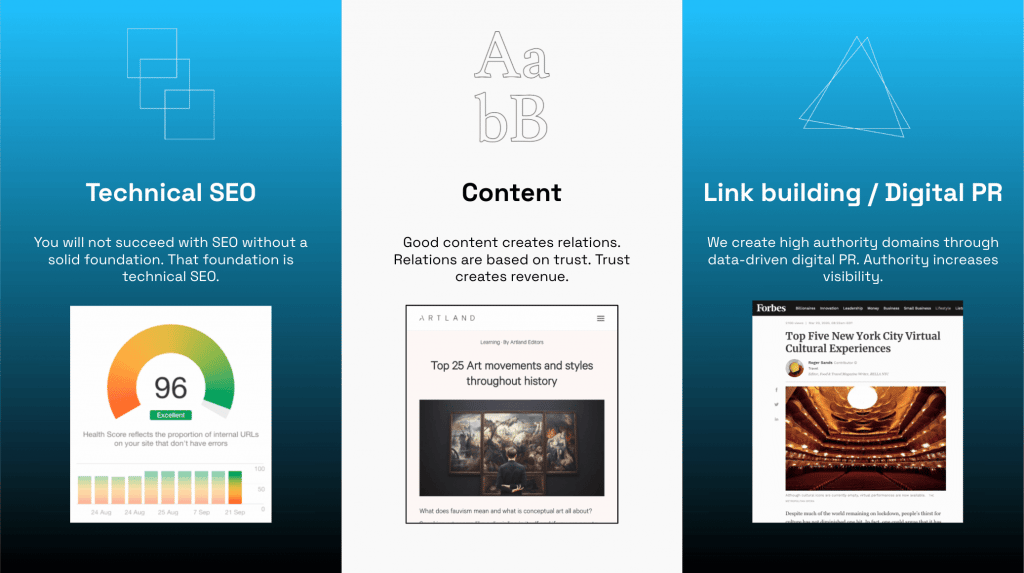
Technical SEO is the foundation. It covers whether the site can be crawled and indexed at all, how fast the templates render, how the URL structure is built, and whether search engines can read the page without guessing. The pages you want to rank should sit no more than three or four clicks from the front page. Technical work rarely wins a keyword on its own, but technical faults reliably lose them.
Content is what actually answers the search. It starts with keyword research that tells you what people look for, in what volume, and with what intent behind it. From there it becomes a question of covering the topic properly rather than mentioning a phrase often. Text, images, tables and video all count.
Links are how the rest of the internet vouches for you. A link from a relevant, trusted site works like a recommendation, and the quality of the source matters far more than the count. Our own model for judging a link is the triangle: relevance, authority and trustworthiness.
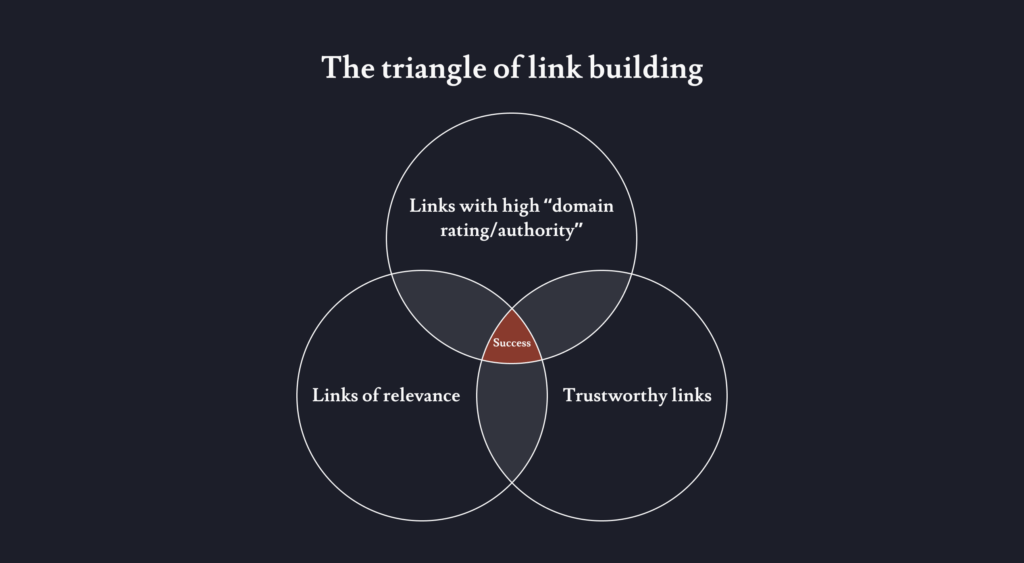
Bought links from private blog networks fall outside Google's guidelines and usually cost more than they ever returned. Link building that holds up is content worth citing, put in front of people with a reason to cite it.
The same foundation now feeds AI answers
Search is no longer one interface. People ask ChatGPT before a purchase, read an AI Overview without clicking anything, and use Perplexity or Copilot for research. What has not changed is where those systems get their material: they retrieve and cite pages from the same web Google ranks. A crawlable site with clear entities and real authority is the entry ticket to both, which is why the AI search pillar sits alongside the classic disciplines rather than replacing them.
The one rule: search intent
If you take a single principle from this page, take this one. Behind every search sits an intention, and the content that matches the intention wins. Someone typing "best accounting software" is comparing, not buying. Someone typing "what is hreflang" wants an explanation, not a product page.
The results page hands you the answer for free. If Google shows guides, guides win. If it shows category pages, category pages win. Reading the results before you produce anything is the cheapest analysis in the field, and it keeps you aligned through every algorithm update, because intent is the thing every update is trying to serve better.
How long does it take?
Longer than most plans allow for. An Ahrefs study of two million keywords found that pages reaching the first page of Google averaged more than two years of age, and only 22% of first-page results were less than a year old.
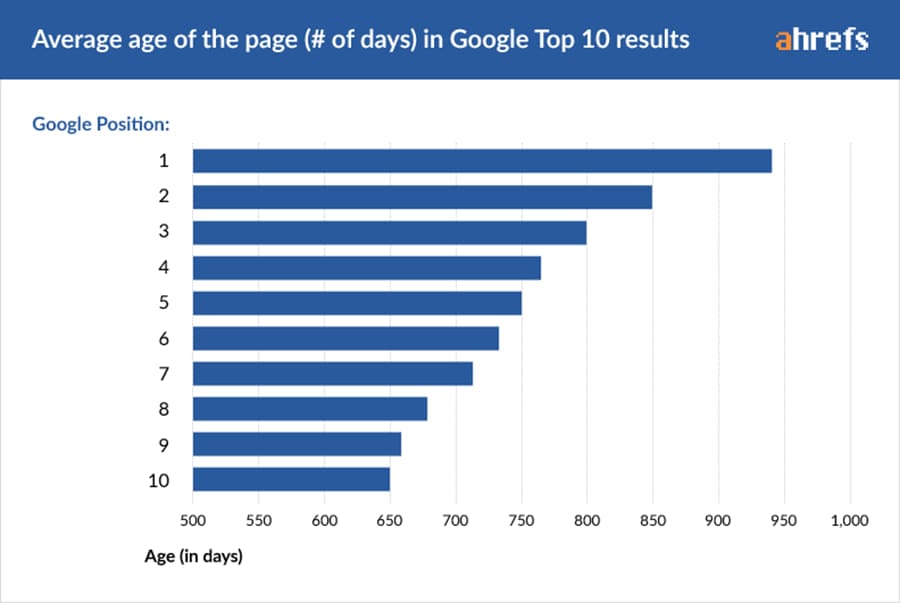
Established domains move faster than new ones, and focused work moves faster than scattered work. Pages already sitting mid page one are quicker wins than new topics, which is usually where we start on a site we have not worked on before.
A checklist to work from
The list below sorts the basics under the three pillars. It is not the whole discipline, but a site that clears all of it is already ahead of most of its competition.
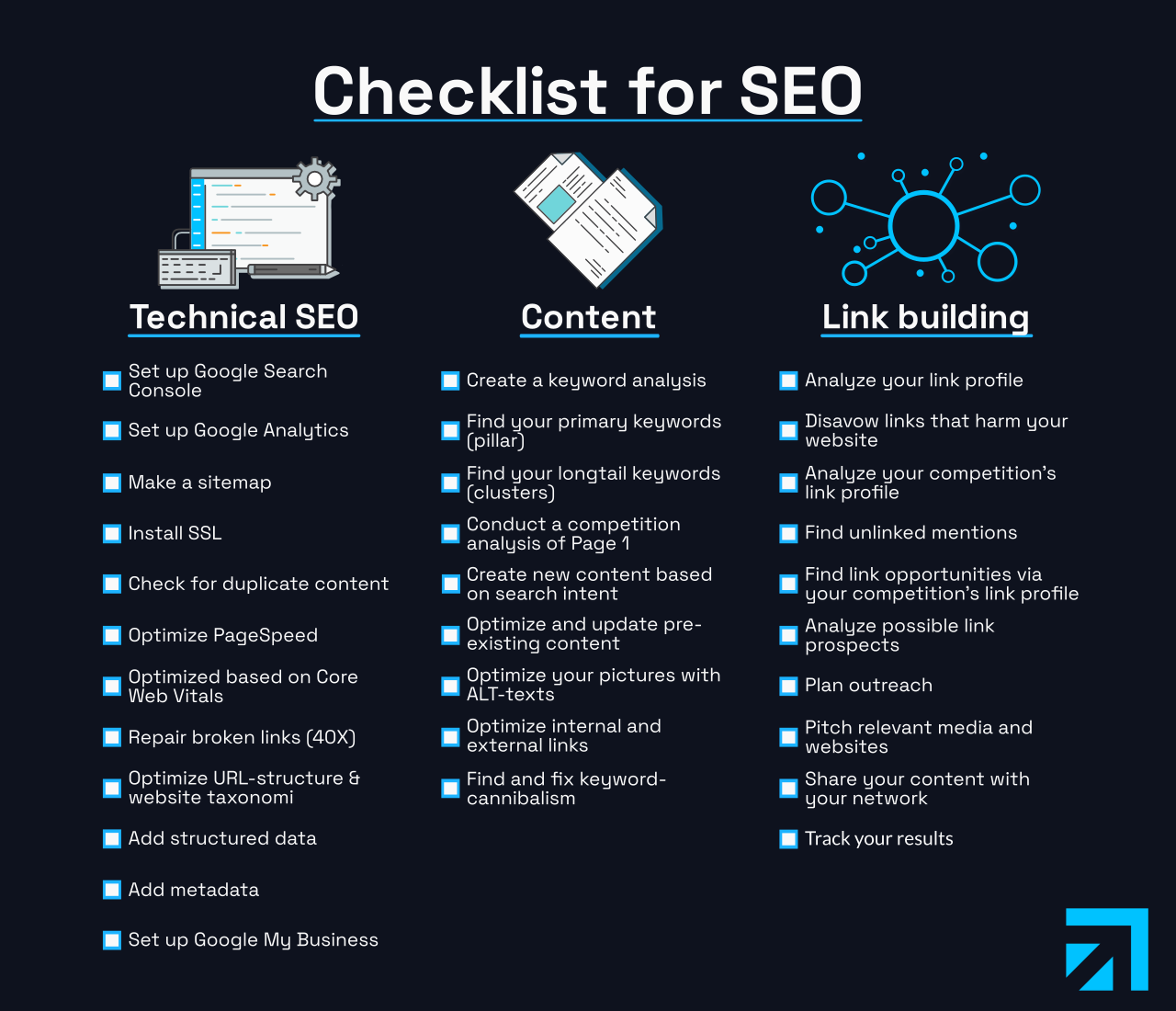
Work through it in that order. Clear the technical faults that block indexing, then build content against real search intent, then earn the links that let the content compete.
Want to know where your own site stands before you start? A free SEO analysis gives you the picture across classic search and AI search, built by hand on your market rather than generated from a template.