International SEO
International SEO takes more than translation. Get the guide to domain structure, hreflang, local keyword research and E-E-A-T across several markets.
Going from one market to several is the point where most SEO programs get harder in a way nobody warned the team about. The site that ranks at home suddenly competes against local players who have been building authority in their own language for a decade, and the shortcuts that seem obvious, one domain, machine translation, the same keywords everywhere, are the ones that cost the most to undo.
This is the guide we work from. Eight decisions, in the order they actually have to be made.
1. Choose the right URL structure
Before anything else, decide how the markets live together. Three structures work, and the choice is mostly about resources rather than about theory.
Country code top-level domains (example.dk, example.se, example.no) give the clearest geographic signal and the cleanest separation. They are also the most expensive to run: several domains, several sets of authority to build, several technical setups. In an ideal world with the resources behind it, this is the strongest structure.
Subdomains (se.example.com) are the middle path. Lower overhead than separate domains, still a clear separation per market.
Subdirectories (example.com/se/) concentrate all authority on one domain and are by far the cheapest to maintain. For most companies entering their second and third market, this is the sensible answer.
Pick based on what you can maintain, not on what looks best on a slide. A neglected ccTLD performs worse than a well-run subdirectory, and the taxonomy and site architecture work is the same either way.
2. Get hreflang right
Hreflang is an HTML attribute that tells search engines which language and which geographic audience a page targets. It looks like this:

The tail on the value, "en-gb" in this example, is the part that carries the meaning: language first, then country. Get the pairs wrong and you send the German page to Austrian users while telling Google the Swiss page is Swedish.
Note: hreflang is not supported by Bing or Baidu. Both read language and location from content-language metadata instead.

So decide early which engines each market is optimized against. If Bing matters for your buyers, which it often does in B2B, the metadata has to be there alongside hreflang, not instead of it. The other engines and where they matter are covered under alternative search engines.
3. Keywords and SERPs vary by country
The algorithm is broadly universal. The results are not. Search for the same product in Sweden and in the United States and you can get two entirely different result pages, with different formats, different competitors and different intent behind the same words.
Start every market with its own keyword research rather than a translated list. Search volume is never the same across countries, and meaning shifts. "SEO" means the same thing everywhere. "Football" does not, and a page written for one meaning is invisible for the other.
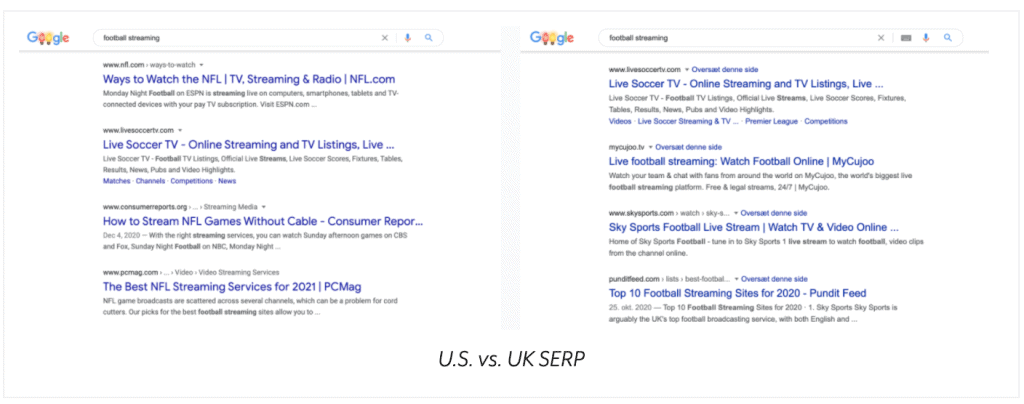
Choose targets on volume and on intent together. A high-volume term with informational intent will not fill your pipeline, and a low-volume term with clear commercial intent often will. The method is the same as at home, described under keyword research, applied once per market.
4. Avoid machine translation
Translation plugins make life easier and produce content faster, and we have yet to see one produce a page that competes. The errors are rarely dramatic. They are small: a preposition that no native speaker would use, a term that is technically correct and never said out loud, a heading that reads as translated the moment a local buyer sees it.
Use local writers who understand both the subject and the context. Written from scratch in the target language, with the same structure and the same arguments, is a different product from a translated page. It is also the approach we apply to our own four markets, and the reason our Nordic sites are not versions of each other.
5. E-E-A-T is market specific
E-E-A-T stands for Experience, Expertise, Authoritativeness and Trustworthiness, and Google expects content to demonstrate all four before treating it as reliable. The part teams forget in international work is that trust signals are local.
What to get in place per market:
- Named authors with real biographies on editorial content
- Local company details, address and contact information
- Reviews and references from that market rather than translated ones
- Content that shows experience with local conditions, regulation and buying habits
- Low-quality pages rewritten or removed rather than translated
6. Build local links, not just links
Links still work, because they are references, and references do not go out of fashion. In international SEO they carry an extra signal: origin. A site receiving many links from .de domains tells Google it is relevant to German users, and German results follow.
Quality over quantity, and locality over both. A relevant link from a modest site in the right country and language does more for that market than a batch of irrelevant links from anywhere. The most reliable route to them is relationships with site owners and marketers in the industry, in that market, which is the substance of link building.
7. Prepare page experience per market
Google's updates keep circling back to page experience, and international sites fail it in specific ways: a CDN that serves one region well and another badly, cookie banners built for one jurisdiction, fonts and scripts loaded from services that are slow in the target country.
Measure Core Web Vitals per market rather than as a site average. INP and LCP on a mid-range Android phone on a Swedish mobile network is the number that matters for Swedish rankings, and it can look nothing like your dashboard at head office.
8. Watch local trends and local AI surfaces
Search behavior moves at different speeds in different countries, and seasonality rarely lines up. A term that peaks in March in one market peaks in June in another, and planning content on a single calendar means arriving late in half your markets.
The same is now true of AI search. Adoption of assistants, and the rollout of features like Google's AI Mode, varies by country and by regulation, so your visibility in AI answers has to be measured per market as well. That is the job of LLM monitoring, run per language.
Turn the strategy into a plan
Following the eight steps puts you in the right direction. The part that decides whether it happens is the execution plan: split the work into technical, content and link building, put it on a calendar with the preparation each item needs, and give each market an owner.
Working across Danish, Swedish, Norwegian and English every day is where our own experience with this comes from, and multilingual markets with high competition and early AI adoption are good training for harder ones. If you want a picture of your international potential, start with a free SEO analysis, or look at how we run international SEO as a delivery.